§0 Sammanfattning
Instrumentet rättade sin upphovsman innan det hann berömma honom.
Roots is a new Draken instrument: 2.26 million words in fourteen languages and their ancestors, joined by 3.38 million etymological links, with four expert dictionaries as referee [D]. Its first job was to test the hyperliminal cut that Betenskap (DRK-199) defined, the bite that joins splitting to feeding [D]. The cut holds: in the *bʰeyd- family no feeding word can be reached from a splitting word once the biting words are removed [D]. But it holds only in Germanic, which corrects that post, and the half of the cut that recurs across unrelated language families is not split-to-bite but bite-to-eat [D]. This post shows the instrument in five screenshots and invites readers to ask for the code. It does not claim that Roots is complete, that its concept labels are dense, or that a colexification proves a shared mind.
Epistemic ledger. Every substantive claim carries one tag:
| Tag | Meaning |
|---|---|
| [E] | Established: textbook consensus, a proved theorem, direct measurement, or a standard etymology (SAOB, Hellquist, OED, etymonline) |
| [S] | Supported: leading model or majority scholarly reading, strong but incomplete evidence |
| [H] | Hypothesis: open, contested, or without decisive evidence |
| [D] | Draken synthesis: structural claim made by this corpus, submitted for Clinch review |
| [M] | Metaphor or paronomasia: a pointer, not a referent or root (per The Pendragon Source, DRK-165) |
§1 The instrument
§1.1 What it holds
Roots reads the English Wiktionary through Wiktextract (Ylonen 2022) for Swedish, English, Finnish, German, Latin, Greek, Russian, Mandarin, Japanese, Tibetan, Indonesian, Spanish, Sanskrit and Arabic, together with every ancestor and relative those entries name [D]. Each word becomes a node, each etymology template or descendants list becomes a typed link (inherited, borrowed, formed within a language, cognate), and every link keeps the dictionary entry it came from [D]. Meanings are mapped to Concepticon concept sets (List, Cysouw & Forkel 2016), and the worldwide colexification network of CLICS 4 (Tjuka et al. 2026) records which concepts unrelated language families name with one word [E].
On top of the crowd-sourced layer sit four expert dictionaries: Hellquist (1922) for Swedish, Lewis & Short (1879) for Latin, Liddell-Scott-Jones for Ancient Greek and Webster's Revised Unabridged Dictionary (1913) for English, 227,833 entries in all [D]. A link counts as confirmed when the etymology in an expert entry for one end names the other end, and 115,601 links pass that test [D]. The match is a string match, not a parse, so the instrument always shows the passage beside the claim and leaves the reading to the reader [D].
§1.2 What it refuses
Three rules keep the graph honest [D]. A word that is spelled like another word is not the same word: 312,489 links that point at an ambiguous homograph are left out rather than guessed [D]. Across languages a chain may only inherit or borrow; word formation is followed only inside one language, so a story cannot leap between unrelated words through a shared affix [D]. And a meaning shift is reported only where both ends carry a concept label, so silence in the labels is shown as silence, not as continuity [D].
This is the referee principle of 知行合一 (DRK-131) applied to etymology: the instrument does not grade its own links, the dictionaries do, and where they say nothing the panel says so [D].
§2 A story from splitting to rap
§2.1 The Roots view
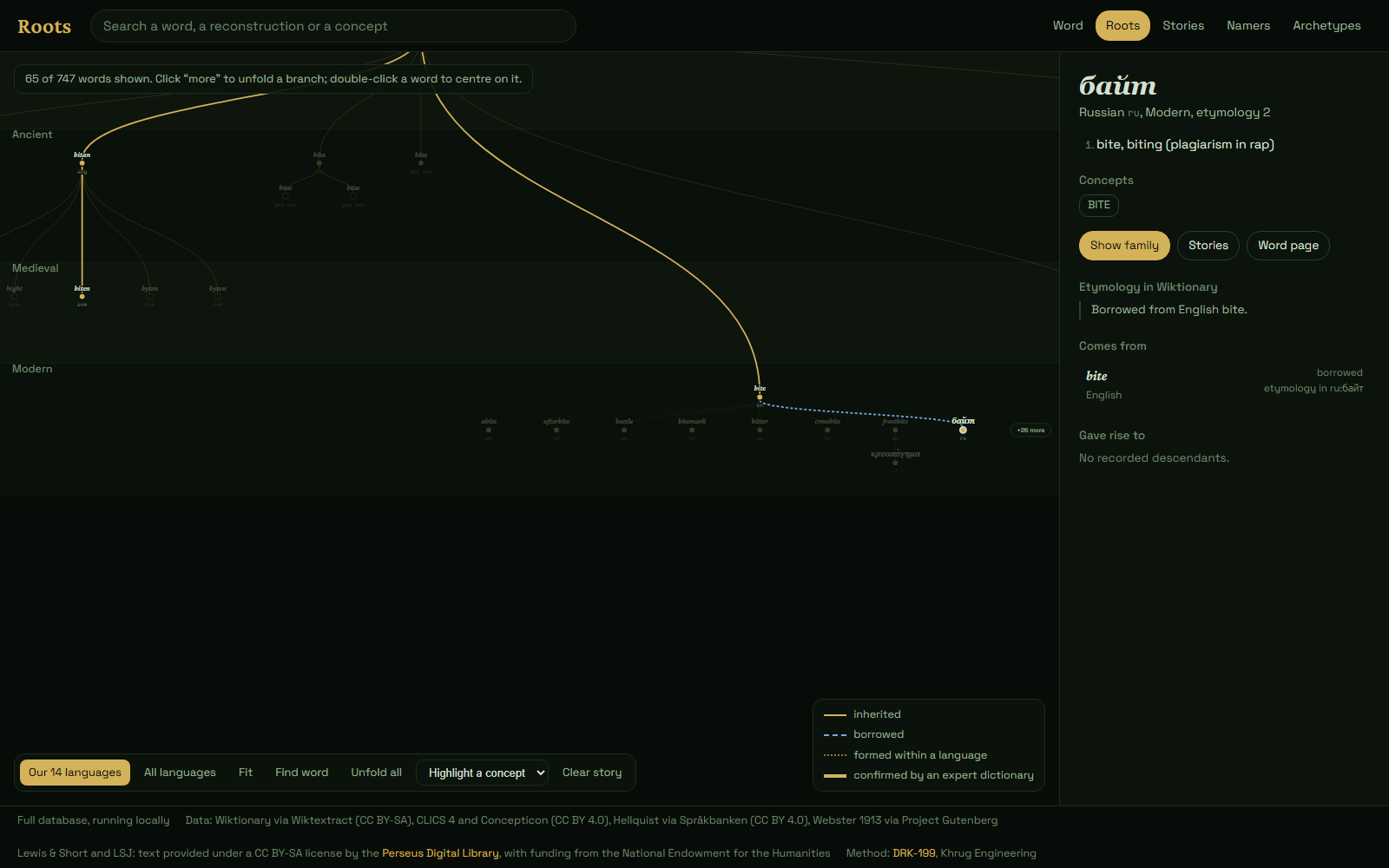
The Roots view draws one family as a root system growing down through five bands of time, from Proto-Indo-European to the living languages [D]. Gold lines are inheritance, blue dashed lines are borrowing, dotted lines are word formation, and a thick line is a link confirmed by an expert dictionary [D]. The *bʰeyd- family holds 747 words in 116 languages and 954 links, of which 22 are confirmed by an expert entry [D]. A family that size cannot be drawn whole, so branches fold into "+N more" and open on a click [D].
§2.2 Stories
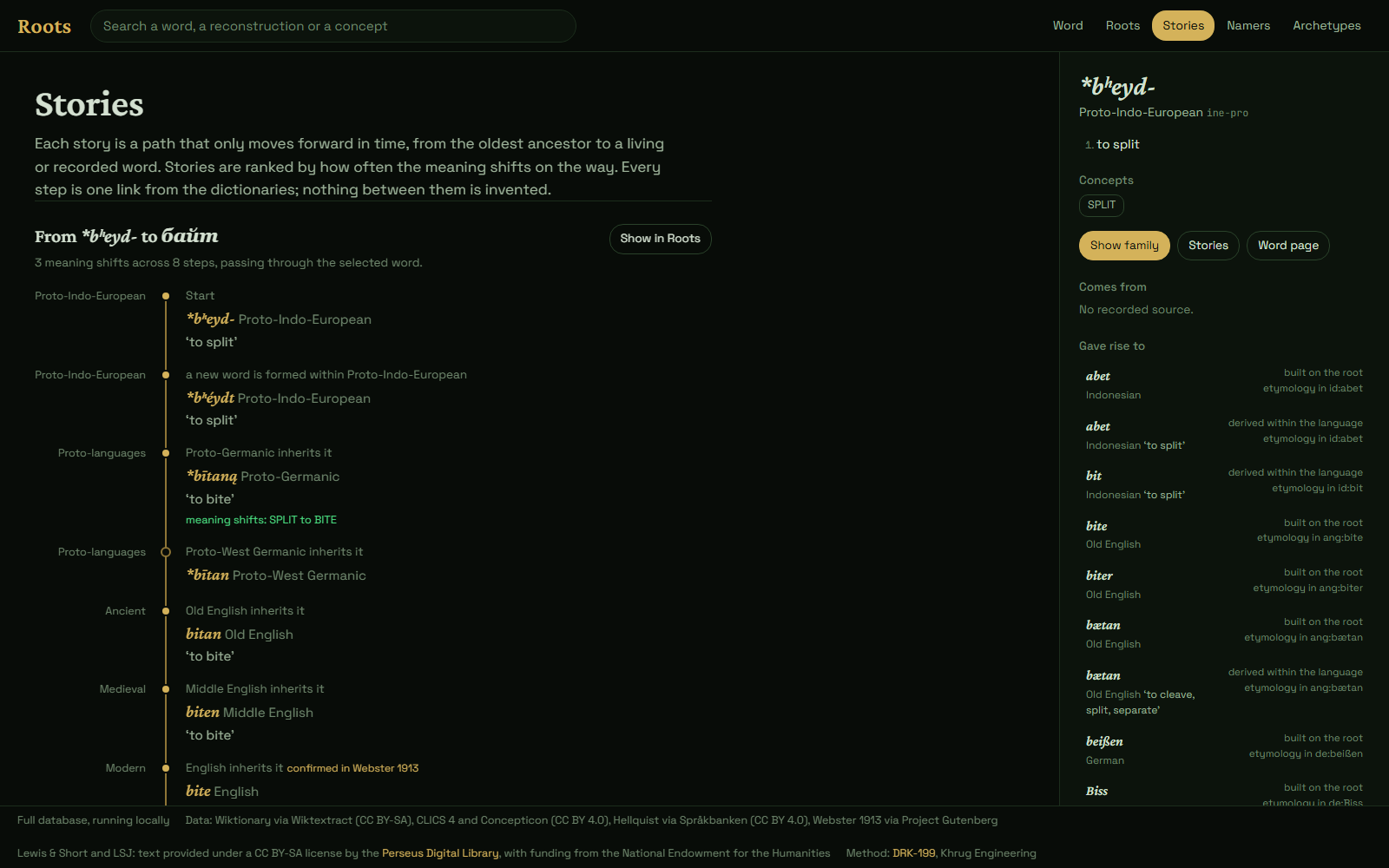
A story is a path that only moves forward in time, the time-respecting path of temporal network theory (Holme & Saramäki 2012) [E]. Roots ranks the stories of a family by how often the meaning shifts on the way and keeps them diverse by allowing one story per ancient trunk [D]. The first story of *bʰeyd- starts at "to split", turns to "to bite" in Proto-Germanic, and ends in Russian байт, which Wiktionary records as a slang borrowing from English bite meaning plagiarism in rap [S]. The same spelling байт also means a computer byte, from English byte, and Roots keeps the two words apart because their etymologies differ [D].
A story is only as good as each of its links. Another story of the same family runs from *bʰeyd- through Proto-Germanic *baitaz to English boat and Japanese ボート; that the boat was named for a split or hollowed log is a proposal, not a consensus [H]. Roots draws it because Wiktionary links it, and the panel shows which entry made the claim, so a reader can see that this link is weaker than the bite link Webster confirms [D].
§3 The bite, tested
§3.1 The calibration
Betenskap (DRK-199) claimed that bite is a cut vertex: remove the biting senses and the splitting senses (fissure, cleaving wood) fall apart from the feeding senses (bait, pasture, bitter) [D]. A cut vertex, or articulation point, is a node whose removal disconnects a graph, and Tarjan's depth-first algorithm finds all of them in linear time (Tarjan 1972) [E]. Roots turns the claim into a test: label every word of the family with its concepts, delete the words labelled BITE, and ask whether any word labelled FEED is still reachable from a word labelled SPLIT [D].
None is [D]. In the *bʰeyd- family every path from splitting to feeding passes through one of three Proto-Germanic words: *bītaną "to bite", *baitijaną "to make bite" and *baitō "bait" [D]. The bite that the post placed at the joint is there [D]. Read through The Bite (DRK-184), the jaw that closes is the place where splitting turns into eating [M].
§3.2 The evidence panel
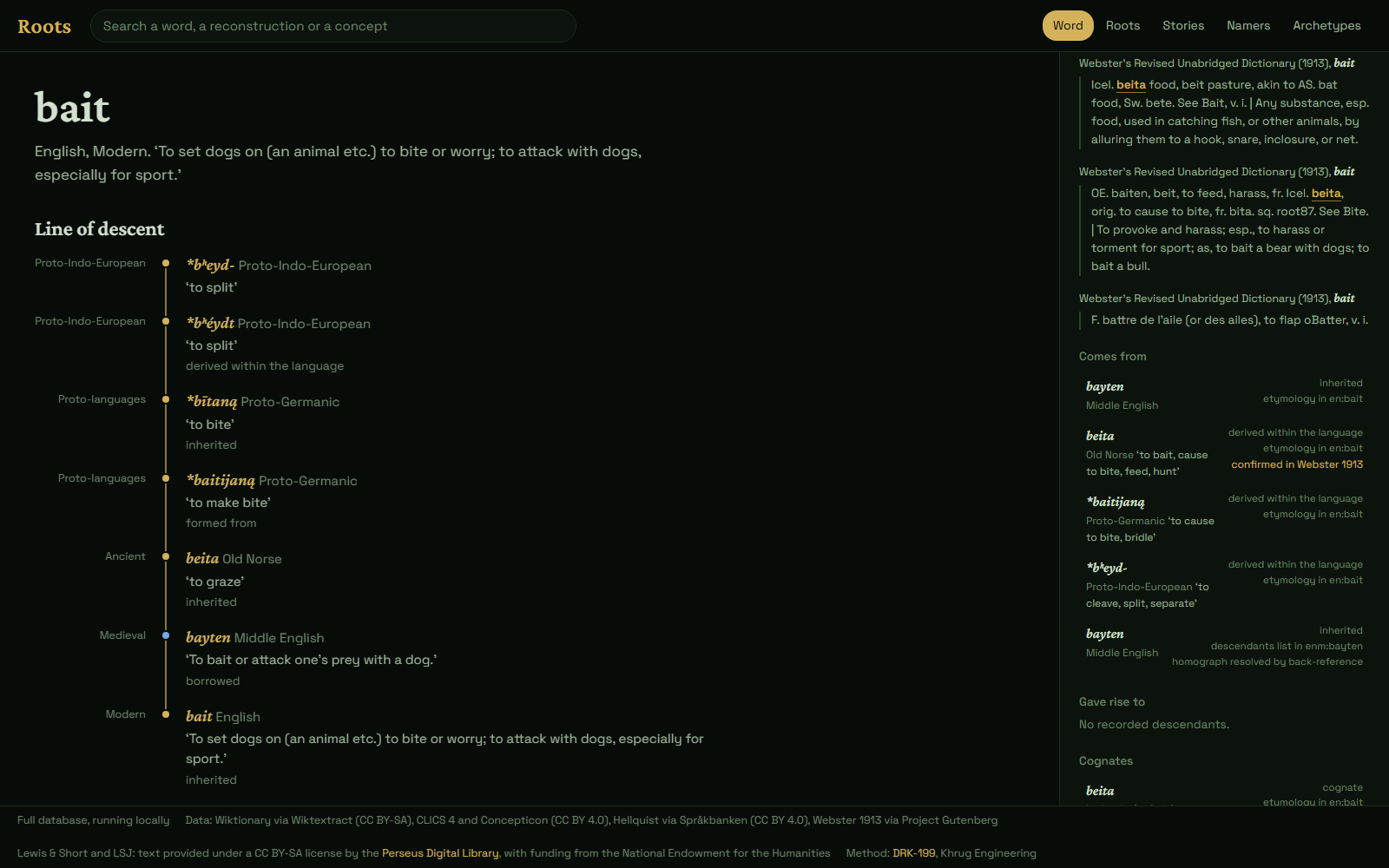
The expert layer is what lets the test be checked by eye [D]. Webster's Revised Unabridged Dictionary (1913) derives the verb bait "fr. Icel. beita, orig. to cause to bite", and Roots marks that link confirmed [E]. Hellquist (1922) derives Swedish bita from the Indo-European root bhid and names Latin findere as its relative, and Lewis & Short (1879) under findo point back to Sanskrit bhid-, German beissen and English bite [E]. The panel also shows what the string match gets wrong: one of Webster's three bait entries is the falconer's homograph, from French battre, and it attaches because the spelling is the same [D].
§3.3 The correction
§7.2 of Betenskap (DRK-199) said the joint is "attested in Germanic and Latin on independent evidence" [D]. Roots does not support the Latin half: every Latin word in the family, findo and its derivatives, carries splitting senses only, and Lewis & Short connect findo to bite as a cognate, not as a word that itself bites [D]. The split-to-bite turn is a Germanic event, inherited by every Germanic language from one ancestor, so by the same post's own §5.2 it is attested in one tradition, not several [D].
The test is also biased toward passing [D]. Only about 104 of the roughly 700 words in the family carry a concept label, and an unlabelled word cannot be a feeding word in the test; a dense labelling could reveal a path the sparse one hides [D].
§4 The half that is archetypal
§4.1 Namers
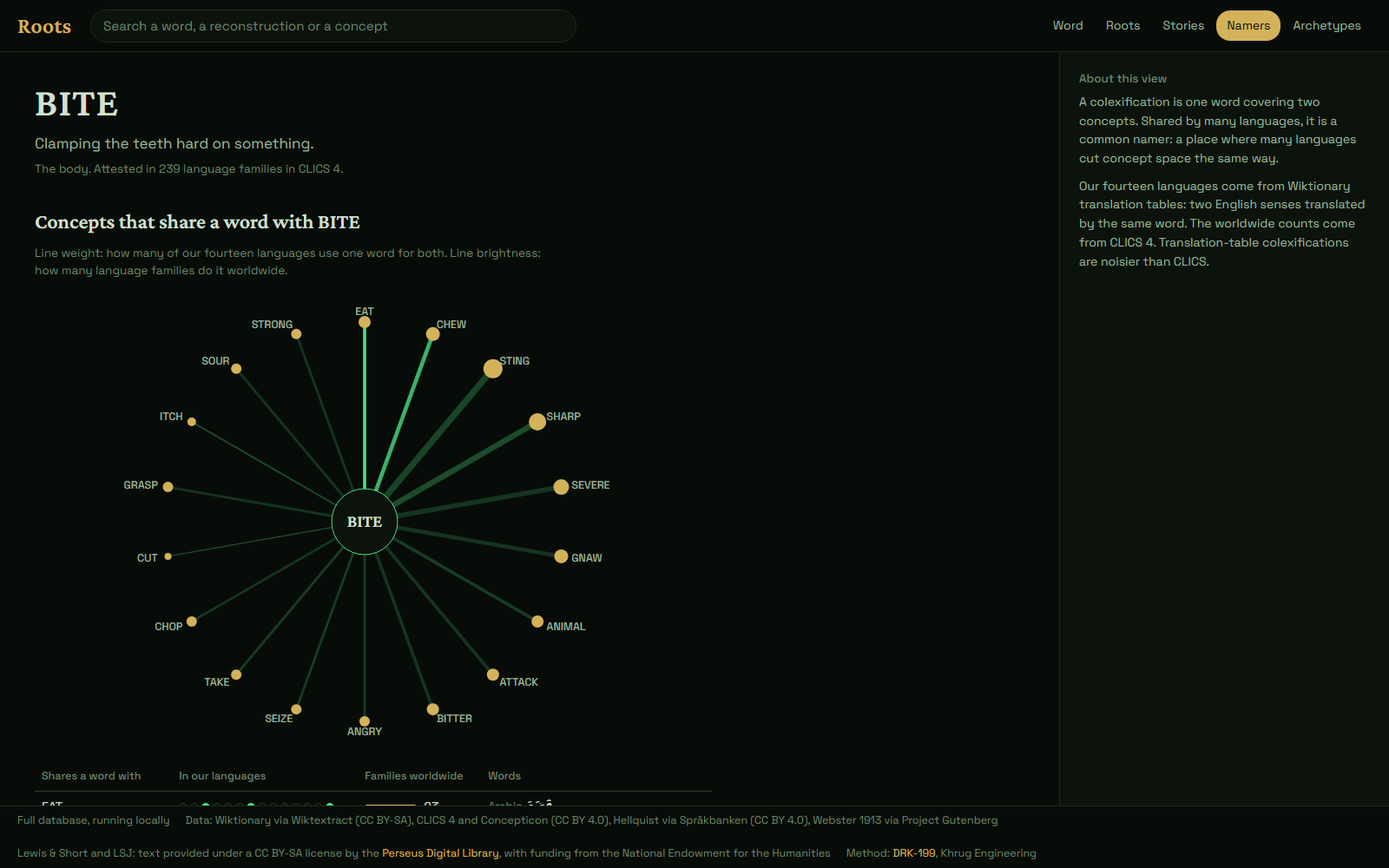
A colexification is one word covering two concepts, and CLICS 4 counts in how many language families each pair is colexified (Tjuka et al. 2026) [E]. BITE is attested in 239 families [E]. BITE and EAT share a word in 23 families, BITE and CHEW in 17, and BITE and CUT in 6 [E]. BITE and SPLIT share a word in none [E]. Among our fourteen languages, Wiktionary translation tables give one word for biting and eating in Arabic, Finnish and Russian, a noisier source than CLICS [S].
§4.2 Homology and convergence
The two halves of the bite are different kinds of evidence [D]. SPLIT to BITE is homology: one shift, made once in Proto-Germanic and inherited, with no family anywhere that names both with one word [D]. BITE to EAT is convergence: 23 families reached the same joint without a common ancestor that Roots or CLICS can see [D]. Under the reading of The Common Base (DRK-177), where an archetype is protocol rather than transmission, only the second half qualifies [D].
A minsta gemensamma nämnare (MGN) is a concept joint that several unrelated language families reach independently, so that it is shared without having been transmitted [D]. The bite-to-eat joint is an MGN; the split-to-bite joint is a family heirloom [D]. A hyperliminal cut can therefore be built from two parts with different epistemic weight, and Roots is the first tool in the corpus that tells them apart [D].
§5 Archetypes
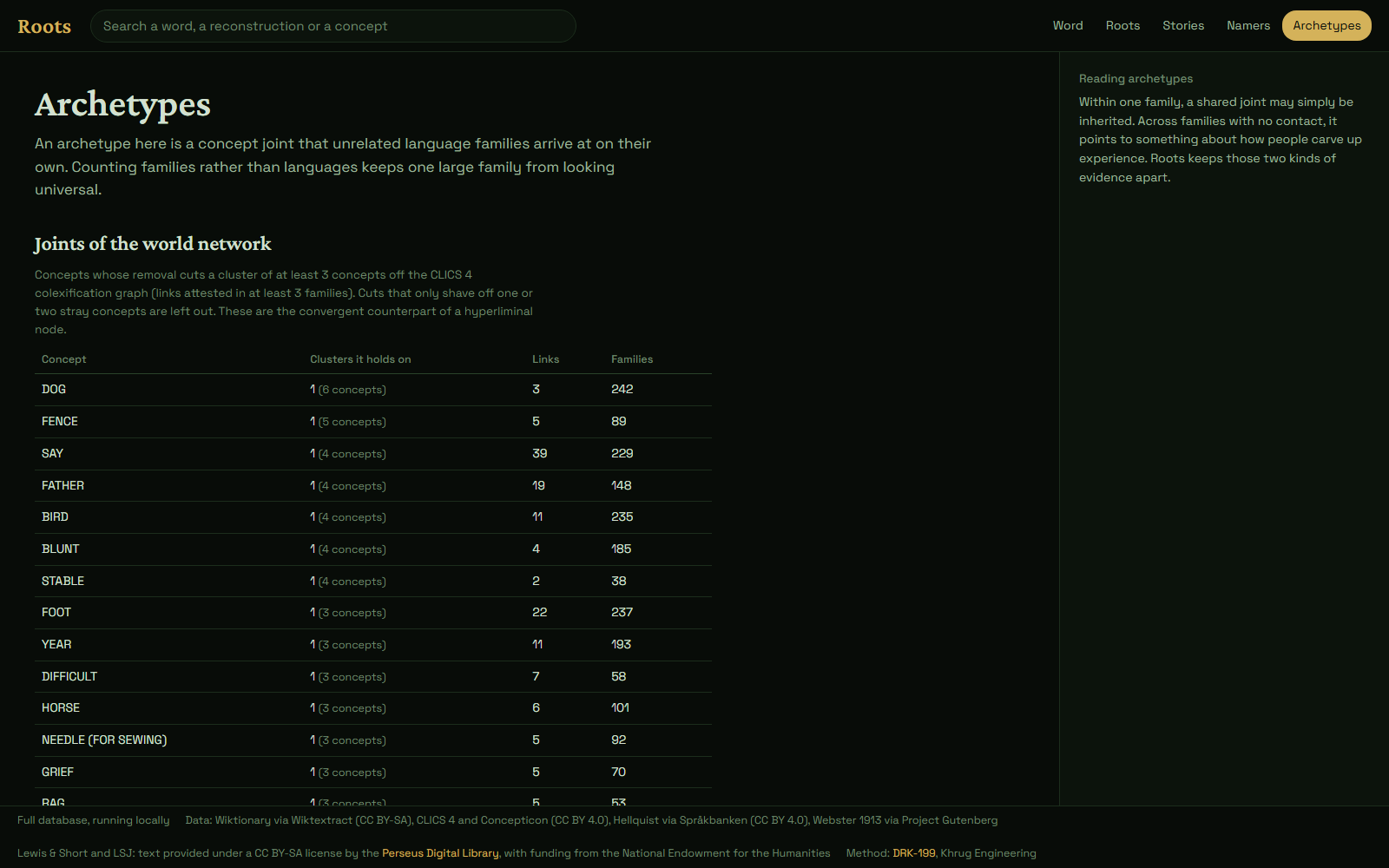
The Archetypes view runs the same cut-vertex test on the world network instead of one family [D]. It keeps colexifications attested in at least three families, finds the articulation points with Tarjan's algorithm, and lists the 21 concepts whose removal cuts off a cluster of three or more concepts [D]. DOG holds the largest such cluster, six concepts, and SAY, FATHER and BIRD hold four each [D].
These are candidate MGNs, not proven ones [H]. Families in contact borrow ways of carving meaning as easily as words, and Roots does not yet control for contact or compare the joints against a null model, so a joint shared by neighbours can still look universal [D]. EvoSem (Dehouck et al. 2023) is the nearest earlier work, a database of polysemous cognate sets; Roots differs in joining inherited polysemy and cross-family colexification in one graph and testing joints rather than listing pairs [D].
§6 Ask for the code
Roots runs on one machine [D]. The pipeline is a dozen Python scripts that download the sources, extract fourteen languages, resolve homographs, map concepts and build the expert layer, ending in a 1.6 GB SQLite database built from 3.8 GB of raw data [D]. The app is a local web page served by a small Python server that needs nothing beyond the standard library and a browser [D]. The data are not ours to ship, so the code fetches every source under its own licence, and the footer of the app credits each one [D].
We share the code on request [D]. Use the Contact Khrug form on the front page and say what you would point it at: a root family you want drawn, a colexification you suspect is contact rather than convergence, a language you want added, or a concept joint you want tested the way §3 tested the bite [D]. The instrument is most useful in the hands of someone who knows one language better than its Wiktionary entries do [D].
§7 Falsification (DRK-131)
F1: Cut vertex. §3.1's result is Refuted if, once every word of the *bʰeyd- family carries a checked concept label, a word labelled FEED is reachable from a word labelled SPLIT without passing through a word labelled BITE.
F2: Convergence. §4.2's claim that bite-to-eat is convergent is Refuted if, after sampling one language per contact area or testing against a null model of equally frequent concepts, BITE–EAT colexification is no more frequent than chance.
F3: Scope limit. If F1 and F2 fail, the instrument, its data and the correction to Betenskap (DRK-199) §7.2 stand, and only the readings of bite as a hyperliminal term and of bite-to-eat as an MGN fall.
§8 Provenance and leaks
- The idea of mapping hyperliminality across languages, the name Roots, the fourteen languages, the archetype mode, the stories of MGN traces and the term minsta gemensamma nämnare are Khrug's; the pipeline, the app, the screenshots and this text are Claude's work (Opus 5.5, 2026-10-07 to 2026-10-08); Clinch review has not been performed.
- Wiktionary entries are crowd-sourced and were not checked one by one beyond the words quoted here, Liddell-Scott-Jones rarely carries etymologies so Greek is barely confirmed, the *baitaz–*bʰeyd- link was not checked against a specialist dictionary, and EvoSem was compared from its paper, not its data.
- The calibration labels only about 104 of roughly 700 words in the family, so §3.1 is biased toward passing; the correction to Betenskap (DRK-199) §7.2 on Latin is made here in the open, and that post is left unchanged.
References
- Dehouck, M., François, A., Kalyan, S., Pastor, M. & Kletz, D. (2023). EvoSem: A database of polysemous cognate sets. Proceedings of the 4th Workshop on Computational Approaches to Historical Language Change, 66–75. doi:10.18653/v1/2023.lchange-1.7
- Hellquist, E. (1922). Svensk etymologisk ordbok, entries bita, bete. Digital edition via Språkbanken. spraakbanken.gu.se
- Holme, P. & Saramäki, J. (2012). Temporal networks. Physics Reports 519(3), 97–125. doi:10.1016/j.physrep.2012.03.001
- Lewis, C. T. & Short, C. (1879). A Latin Dictionary, entry findo. Perseus Digital Library. perseus.tufts.edu
- List, J.-M., Cysouw, M. & Forkel, R. (2016). Concepticon: A resource for the linking of concept lists. Proceedings of LREC 2016, 2393–2400.
- Tarjan, R. E. (1972). Depth-first search and linear graph algorithms. SIAM Journal on Computing 1(2), 146–160. doi:10.1137/0201010
- Tjuka, A., Forkel, R., Rzymski, C. & List, J.-M. (2026). CLICS 4 (v1.0). Zenodo. doi:10.5281/zenodo.19608447
- Webster's Revised Unabridged Dictionary (1913), entries bait, bite. Project Gutenberg. gutenberg.org
- Wiktionary, entries байт (Russian, etymology 2), bait, bite, *bʰeyd-. Via Wiktextract. en.wiktionary.org
- Ylonen, T. (2022). Wiktextract: Wiktionary as machine-readable structured data. Proceedings of LREC 2022, 1317–1325.
Operators: Tarjan cut vertex · time-respecting path · Crosslinks: Betenskap (DRK-199) · The Pendragon Source (DRK-165) · The Common Base (DRK-177) · The Bite (DRK-184) · 知行合一 (DRK-131)
Rötterna ljuger inte, men de tiger där ingen har skrivit.
Khrug Engineering · Göteborg · ORCID 0009-0003-8049-7167 · Thesis v5.0, DOI 10.5281/zenodo.23121197 · CC BY-SA 4.0